
Research
This webpage gives an overview of my recent and current research in statistical physics, both in and out of equilibrium. I am interested in systems that reach a balance between large fluctuations and order; between coalescence and breaking; and between short-range repulsion and long-range attraction coming from shared histories.
Fluctuation-dominated Ordered States are unconventional ordered states with extremely large fluctuations [1]. The fluctuations are of the same order as the mean, but do not destroy the order and lead to interesting patterns in space including fractal interfaces. The hallmarks of fluctuation-dominated phase ordering (FDPO) are a distinctive cusp singularity of the scaled two-point correlation function (implying a breakdown of the Porod Law), and a broad distribution of the order parameter.
Fluctuation-dominated phases are found in many types of systems. FDPO provides a systematic framework to discuss fluctuation-dominated states, in theory and experiment. Theoretical examples include passive particles on a fluctuating interface [2], lipid clustering on cell membranes, the Vicsek model of flocking, active nematics, inelastically colliding particles, and a critical 1D Ising model with long-range interactions [3]. In an interesting recent experiment, the IISER Pune group studied phase ordering of colloidal particles driven by an active system composed of E coli bacteria, and showed that the system exhibits distinctive hallmarks of FDPO [4].
Much more intense clustering can occur if there are no hard-core interactions between particles. This results in fluctuation-dominated clustering (FDC), where the cusp is replaced by a stronger singularity, namely a divergence [5], accompanied by strong signatures of intermittency [6]. The plot shows the world lines of passive particles driven by fluctuating interfaces of different types. Shared histories lead to intermittent clustering, and the system exhibits FDC. Different types of nonequilibrium driving give rise to different degrees of clustering, as illustrated in the figure.
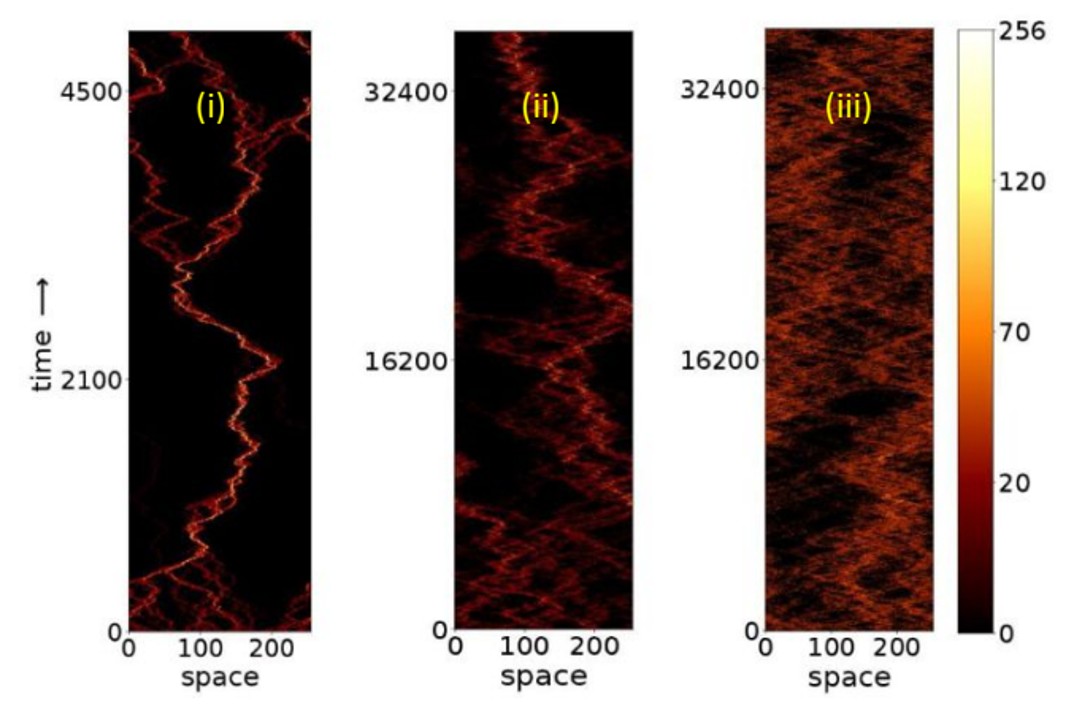
Fig. 1 World lines of particles (shown orange-red) undergoing fluctuation-dominated clustering are shown, when driven by a fluctuating line (not shown in the figure). In cases (i), (ii) and (iii) above, the nature of driving by the lines is very different, resulting in markedly different degrees of particle clustering.
Real-space Condensates with Aggregation-Fragmentation Dynamics occurin mass models of stochastic transport with particle aggregation, wherein a single site holds a finite fraction of the mass in the full system (the real-space analogue of momentum-space Bose-Einstein condensation).
The figure shows a model which exhibits this (CMAM stands for Conserved-Mass Aggregation Model). During the approach to the steady state, local condensates form within a coarsening length scale which grows in time. The distribution of condensate masses exhibits scaling, and this implies anomalous fluctuations: the standard deviation is as large as the mean. Remarkably, the state of the system during coarsening is governed not by the steady state but rather a pre-asymptotic state — a breakdown of the familiar local steady state hypothesis [7].
Real space condensates also occur in the Takayasu model of mass aggregation and input [8]. This points to a new mechanism for condensate formation, not based on conservation of particle number, but rather arising from the breakdown of the law of large numbers [9]. Interestingly, the moving condensate leads to a reorganization of the landscape on a macroscopic scale, and to the occurrence of a new power law in the Takayasu model.
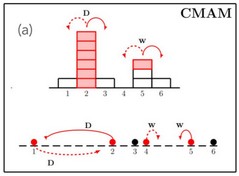
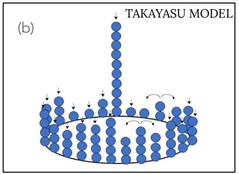
Fig. 2 (a) In the conserved mass aggregation model (CMAM) a particle cluster on a site hops to a neighbouring site and coalesces with the cluster there, while in parallel single particles break off. At a large enough density, mass conservation leads to the formation of a real space condensate. (b) In the Takayasu model of aggregation, there is a continuous input of mass at every site, so no conservation. Moreover, the law of large numbers breaks down, and this turns out to provide a new, robust mechanism for real space condensates to form.
In Coupled Driven Systems, each species (particles, and slopes of an interface) influences the dynamics of the other [10].
There are interesting phase transitions from a disordered state to several types of phases which exhibit phase separation (see the accompanying figure) [11]. Particles and holes are segregated, but interface slopes differ on the macroscopic scale, from one phase to another. The steady state was found exactly in a subspace of the disordered phase, and shown to be of product measure form. The dynamics involves coupled-species propagating modes and can be grouped into universality classes with distinct dynamical exponents [12].
The correlation length diverges as the phase transition is approached, while the order parameter is discontinuous, pointing to a mixed order transition. Interestingly, the separatrix between the disordered and ordered phases is a surface which exhibits fluctuation-dominated phase ordering (FDPO). In a scaled version of the model, static and dynamic properties can be found exactly using fluctuating hydrodynamics [13]. The phase diagram of the scaled model differs in an interesting way from the accompanying figure, which pertains to the unscaled model.
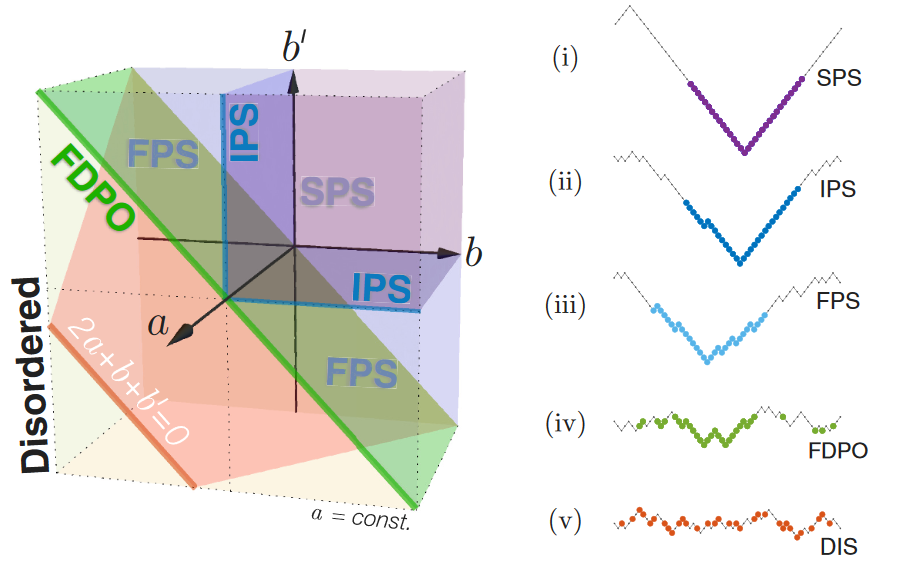
Fig. 3 When particles sliding on a fluctuating surface affect and are affected by the surface dynamics, there are phase transitions to a set of ordered phases. Interestingly, the separatrix between the disordered and ordered phases is a surface in parameter space on which the system exhibits fluctuation-dominated phase ordering.
References:
1. ‘Fluctuation-dominated Phase Ordering’ M. Barma in ‘50 Years of the Renormalization Group’ edited by A. Aharony, O. Entin Wohlmann, D. Huse and L. Radzihovski (World Scientific, Singapore, 2024)
2. ‘Particles sliding on a fluctuating surface: phase separation and power laws’ D. Das and M. Barma Phys. Rev. Lett. 85, 1602 (2000).
3. ‘Fluctuation-dominated phase ordering at a mixed order transition’ M. Barma, S. N. Majumdar and D. Mukamel, J. Phys. A: Math. Theor. 52 254001 (2019).
4. ‘Unconventional Phase Separation and Fractal Interfaces of Colloids in Active Liquids’ P. Kushwaha, P. Jena, P. Mondal, S. Puri, S. Mishra, V. Chikkadi, https://arxiv.org/abs/2508.11000
5. ‘Passive sliders on fluctuating surfaces: strong-clustering states’ A. Nagar, M. Barma and S.N. Majumdar Phys. Rev. Lett. 94, 240601 (2005).
6. ‘Time evolution of intermittency in the passive slider problem’ T. Singha and M. Barma, Phys. Rev. E 97, 010105(R) (2018).
7. ‘Dynamic condensates in aggregation processes with mass injection’ A.Das and M. Barma, Indian J. Phys. 98, 3813–3821 (2024) URL: https://link.springer.com/article/10.1007/s12648-023-03030-1
8. ‘Condensate-induced organization of the mass profile and emergent power laws in the Takayasu aggregation model’ R. Negi, R. G. Pereira and M. Barma , Phys. Rev. E 110, 064132 (2024) URL: https://doi.org/10.1103/PhysRevE.110.064132
9. ‘Coarsening, condensates and extremes in aggregation-fragmentation models’ C. Iyer, A. Das and M. Barma Phys. Rev. E 107, 014122 (2023) URL: https://journals.aps.org/pre/abstract/10.1103/PhysRevE.107.014122
10. ‘Ordered phases in coupled nonequilibrium systems: Static properties’ S. Chakraborty, S. Chatterjee and M. Barma Phys. Rev. E 96, 022127 (2017).
11. ‘Light and heavy particles on a fluctuating surface: Bunchwise balance, irreducible sequences and local density-height correlation’ S. Mahapatra, K. Ramola and M. Barma, Phys. Rev. Research 2, 043279 (2020)
12. ‘Dynamics of coupled modes for sliding particles on a fluctuating landscape’ S. Chakraborty, S. Chatterjee and M. Barma, Phys. Rev. E 100, 042117 (2019).
13. ‘Exact fluctuating hydrodynamics of the scaled light-heavy model’ S. Prakash, M. Barma and K. Ramola J. Stat. Mech. 103208 (2025) URL: https://iopscience.iop.org/article/10.1088/1742-5468/ae09a3/meta