
Research
A major goal of my laboratory is to understand the molecular basis of T cell receptor (TCR) induced ion flux. Calcium flux regulates T cell signaling, differentiation and effector functions. Calcium ions are important signaling intermediates and calcium release activated channels (CRACs) constitute one of the major routes of calcium entry in T lymphocytes. Using a highly interdisciplinary approach, our early work identified the two central components of the CRAC channel complex, the pore forming subunit, CRACM/ Orai and alpha- soluble N-ethylmaleimide sensitive factor (NSF) attachment protein (alpha-SNAP), a closely associated protein that is required for the optimum functionality and selectivity of CRACM/ Orai channels.
Point mutations in CRAC channel components have been associated with a wide range of human diseases, spanning a variety of tissues. We have shown that mutations resulting in the loss of Orai function versus Orai selectivity stimulate distinct downstream signaling cascades, resulting in divergent defects in CD4 T cell differentiation and function. These and further studies in this direction would help in providing the much-needed mechanistic insights into the diverse immunological phenotypes currently associated with CRAC channel mutations in human patients.
We have earlier shown that store-depletion induces the assembly of Orai1 dimers into multimeric channels, on-site. We further showed that the assembly of fully functional and calcium-selective Orai channels is alpha-SNAP dependent. Based on these findings, and our recent targeted RNAi screen, we have recently identified a direct role for Syntaxin11, a Q-SNARE, in the regulation of on-site assembly of CRAC channel pore prior to its gating by Stim1.
Model depicting STX11 mediated priming of Orai1 and its role in T cell signaling and function.
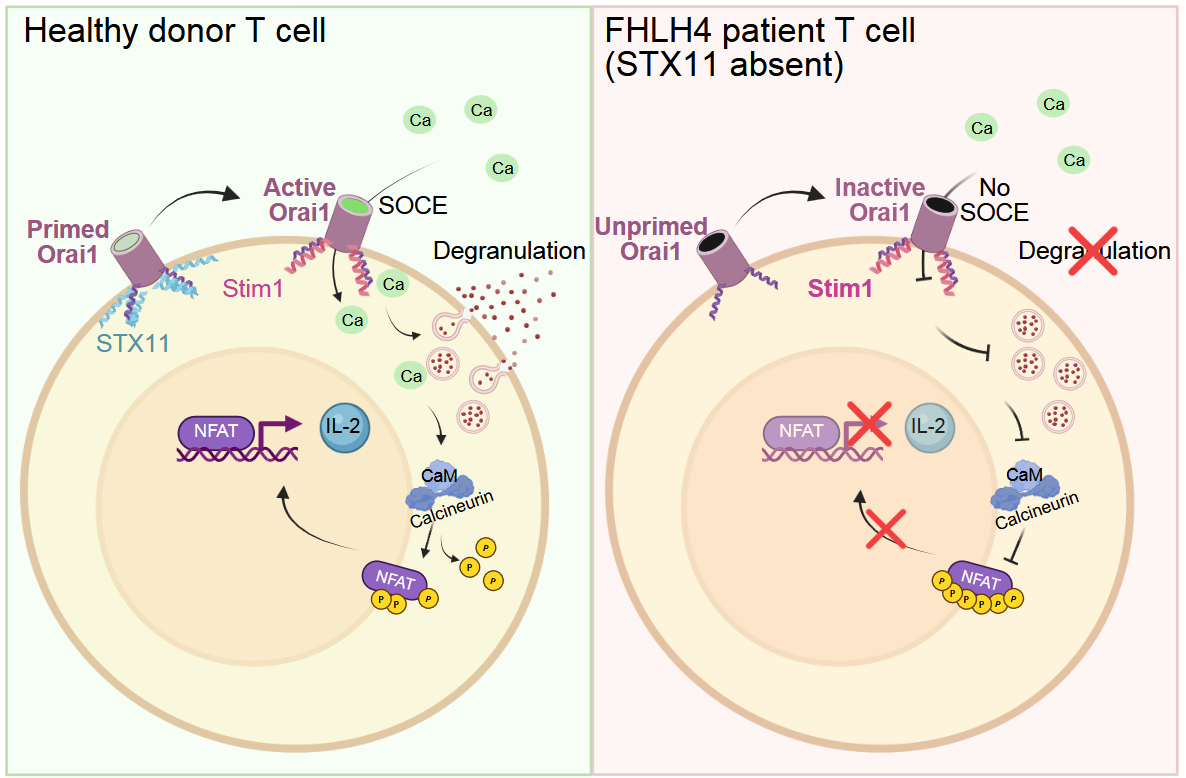
Specific SNAREs were previously found to directly associate with several different ion channels. Yet the molecular basis of these associations and their relevance in ion channel physiology remained unestablished for decades. Our findings of on-site assembly of ion channel pores, and further, the regulation of this process by synaptic family proteins such as Syntaxin11 and alpha-SNAP are fundamentally important in the way we think about the role of these two families of proteins. We are currently testing the hypothesis that the SNARE dependent assembly of ion channel pore is more widespread and is likely signaling dependent.
One of the long-term goals of my laboratory is to determine whether TCR induced ion-flux is tunable depending on the strength and type of upstream signals. In summary, we are interested in systematically characterizing the role of specific synaptic family proteins in the regulation of T cell ion flux, differentiation and function using a highly interdisciplinary, bottom-up approach. The central theme, therefore, is to decipher the fundamental rules that govern antigen receptor induced signaling in T lymphocytes with the goal of benefiting human patients with immunodeficiency, autoimmunity and cancer.